
Duomo di San Ciriaco
Pale stone above the sea
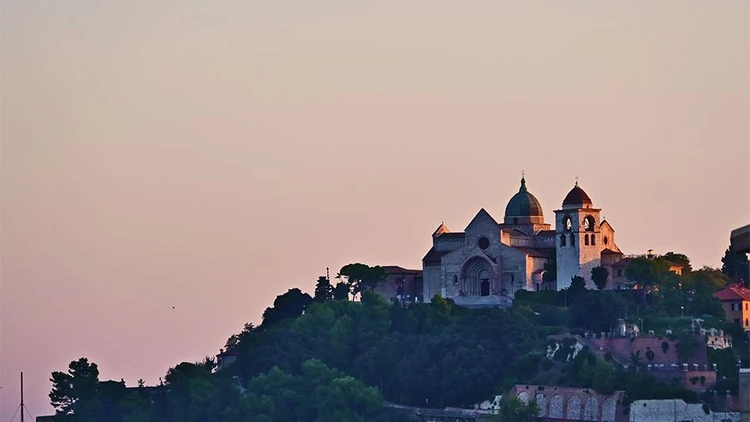
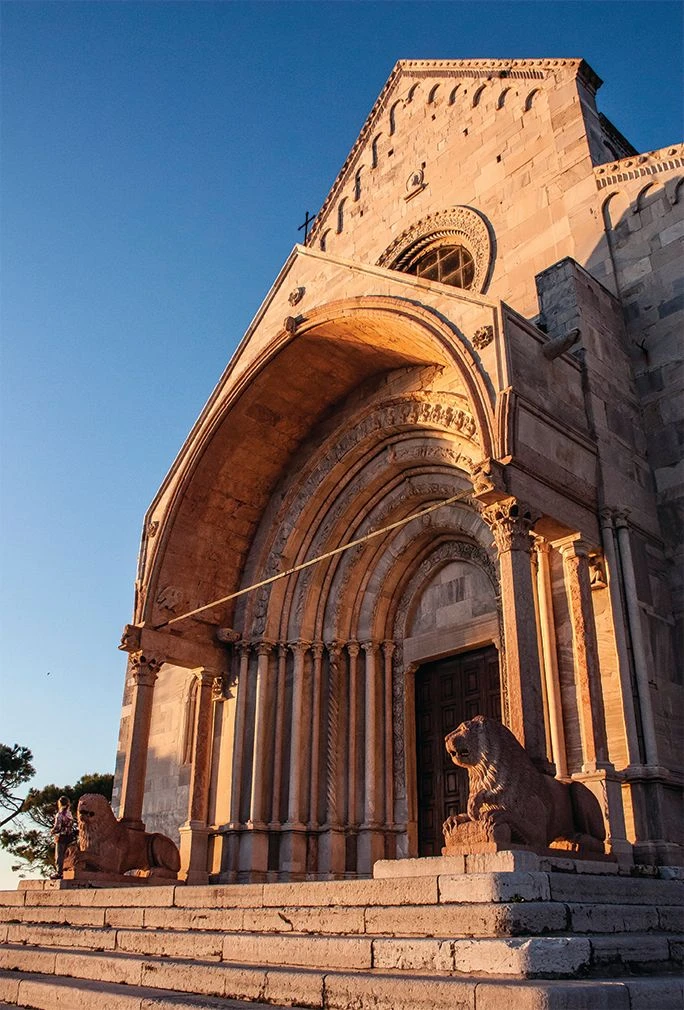
The Duomo di San Ciriaco commands Ancona from the Guasco hill, the highest and oldest point of the city. Here stood the Greek acropolis. Then a temple to Aphrodite. Then an early Christian basilica. The current cathedral, consecrated in 1189, rises above these layers, fusing Romanesque forms with Byzantine influences into something compact, essential.
The façade in Conero stone is restrained. A portico supported by lion-bearing columns introduces the interior. The central rose window filters light with discretion. Nothing is excessive.
The forecourt is already a panorama. The port opens below, the quays laid out like thin lines, the Conero headland closing the horizon. For centuries this cathedral was a reference point for sailors. A fixed mark visible from the sea, before it was ever a place of worship.
Inside, the space is gathered but solemn. The Greek-cross plan is covered by a twelve-sided dome that lightens the whole. The columns come from earlier Roman buildings. The crypt holds the relics of San Ciriaco, patron of the city, and the Blessed Giana.
Over the centuries the Duomo has endured restorations, seismic damage, conservation work. And yet it holds a rare coherence.
From here the whole geography reveals itself: the port, the hills, the line of the Conero. The Duomo is not only a religious monument. It is a point of orientation. It is roots.
Ancona, seen from San Ciriaco, appears for what it is: a city suspended between stone and water.